Loan notes
Every funded loan mints an NFT, the note, to the lender. Whoever holds it is paid back. What a note is and why it exists.
When a loan is funded, the Return contract mints an NFT called a note to the lender. The note is the claim: whoever holds it when the loan ends receives the payback, or the collateral if the borrower does not repay.
When the loan is funded, Leo receives the note: an NFT whose ID is the loan’s ID. Whoever holds it is owed the 1,010 USDG payback.
Properties
| Property | Detail |
|---|---|
| Standard | ERC721, the common NFT standard. Visible in any wallet that shows NFTs. |
| Collection | Return ERC20 Note (RNOTE20), issued by the market contract itself. |
| ID | The loan's ID. One note per loan. |
| Entitles the holder to | The payback, once the loan is paid back; the collateral if the deadline passes unpaid. |
| On-chain metadata | The status, the two tokens and the due date. |
| Lifetime | Minted at funding; destroyed when the loan is paid back or the collateral is claimed. |
What a note looks like
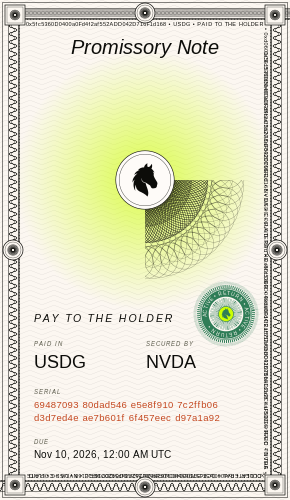
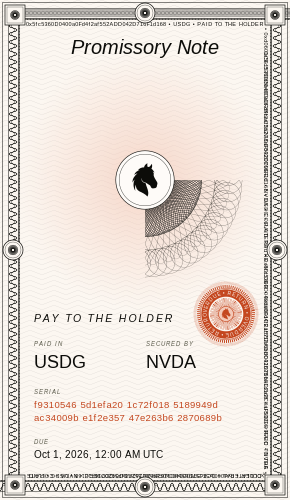
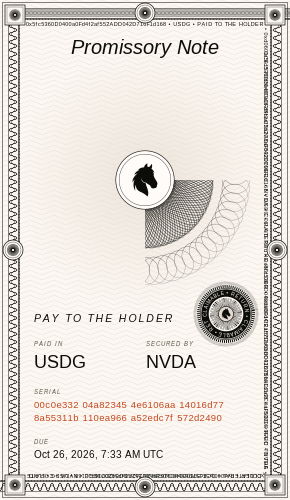
The contract draws each note itself, on-chain: a banknote whose rosette is seeded by the loan's ID, so no two notes look alike. The seal shows the loan's status, and the border runs the addresses of the token it is paid in and the collateral. These samples are rendered by the contract for a USDG loan against NVDA.
Why notes exist
- Lenders can exit early. A lender who needs cash before the due date can sell the note to someone willing to wait. The borrower is not involved and the loan does not change. See Sell or buy a note.
- Any wallet can hold a loan. Multisigs, vaults and custody services can hold notes. Settlement is pushed to the current holder and anyone can trigger it, so the holder needs no special code.
- Borrowers never need to know who is owed. Repayment always goes to the holder at that moment.
A transfer moves the entire claim. Notes cannot be split, and a transfer cannot be reversed.
Last updated
No price liquidations
Why a price crash never closes a Return loan, what that protects borrowers from, and who carries the risk instead.
Fees and revenue
Return earns one fee, 0.3% of the loan amount, paid once by the borrower when the loan opens. Nothing else. What that is as a yearly rate, and where the money goes.